Trump Tariffs on India: US Plans Fresh Duties on 16 Economies – What It Means for the Trade Deal
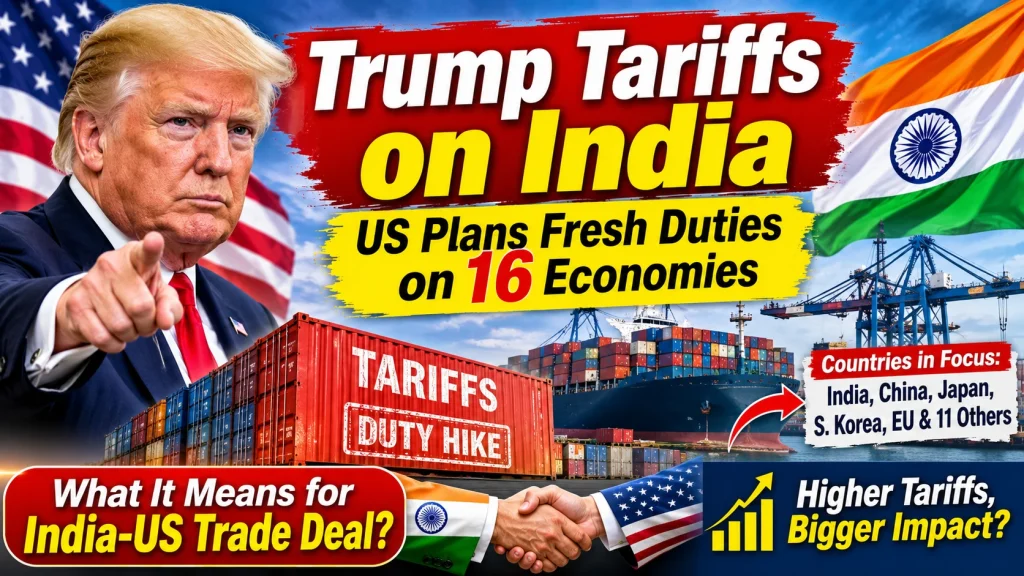
The US is reportedly planning fresh tariffs on 16 economies, including India
Just as India and the US try to close a trade deal, a new tariff cloud has appeared.
Fresh Trump tariffs on India could be on the way. US President Donald Trump’s administration is reportedly preparing new import duties on 16 economies, including India, China, Japan, South Korea and the European Union, over what it calls unfair industrial subsidies. The final tariff rates have not been announced yet.
Key Highlights
- The US is reportedly planning new tariffs on 16 economies, including India.
- The move follows a Section 301 probe into industrial subsidies that began on March 11.
- Steel, aluminium and cars may be left out, as they already face separate duties.
- India could reportedly face higher rates than Japan, South Korea and the EU.
- The White House and USTR have not commented publicly on the reports.
Why Is the US Planning Trump Tariffs on India and 15 Others?
The plan comes from an investigation started on March 11 under Section 301 of the US Trade Act of 1974. This law lets the US President impose duties on trade practices seen as unfair to American businesses. Reports by The Wall Street Journal and Bloomberg say the US Trade Representative’s office may publish its findings within days, though the timing could still change.
US Trade Representative Jamieson Greer has argued that government subsidies in these economies have created too much factory capacity. That, he says, lets their companies sell cheap goods abroad and hurts US manufacturers.
Government subsidies have built excess industrial capacity, allowing foreign firms to undercut American manufacturers with cheaper goods.
USTR Jamieson Greer’s argument, as reported (paraphrased)
Which 16 Countries Face New US Tariffs?
The economies covered by the probe are India, China, Japan, South Korea, Vietnam, Taiwan, Thailand, Malaysia, Indonesia, Cambodia, Bangladesh, Singapore, Switzerland, Norway, Mexico and the European Union. Reports suggest the rates will not be the same for everyone.
| Group | Economies | Reported expectation |
|---|---|---|
| Countries with US trade deals | Japan, South Korea, EU | 15% or lower |
| Countries still negotiating | India, Vietnam and others | Higher than deal partners |
| Biggest target | China | Steepest tariffs |
| Likely exempt goods | Steel, aluminium, autos | Already under separate duties |
India US Trade Deal: Where Talks Stand
India and the US agreed on a framework for an interim trade deal in February. Talks restarted after the US Supreme Court struck down Trump’s earlier tariffs, imposed under an emergency powers law, in February 2026. The new duties are part of Washington’s effort to replace those cancelled tariffs, according to The Federal’s report on the tariff plan.
New Delhi wants Indian goods to face lower US duties than goods from rivals such as Bangladesh, Vietnam and Cambodia. If India ends up with a higher rate than deal partners like Japan or the EU, Indian exporters could find it harder to compete in the US market.
There is another layer too. In July, the US brought in tariffs of 10% to 12.5% on dozens of trading partners over forced-labour rules. The new subsidy-linked duties are reportedly expected to be added on top of those.
What About China?
China is expected to face the highest rates. Its trade surplus reached nearly $1.2 trillion last year. Trump met Chinese President Xi Jinping in Shenzhen last week, as we reported in our story on the Shenzhen summit declaration, but the two sides did not fully settle their trade differences.
FAQs
Has the US announced new tariffs on India?
Not yet. Reports say an announcement may come soon, but the rates and timing have not been made public.
What is a Section 301 investigation?
It is a probe under the US Trade Act of 1974 that allows the US President to impose duties on trade practices seen as unfair to US commerce.
Which goods may be exempt?
Steel, aluminium and automobiles may be left out because they already face separate national-security tariffs.
Will this affect the India-US trade deal?
It could add pressure, as both sides are still working on an interim deal. The White House and the USTR have not publicly responded to the reports so far.
How do you think India should respond to new US tariffs? Share your view in the comments!
This article is for information only and is not investment advice.
Details as reported by The Federal, India.com and Gujarat Samachar, citing The Wall Street Journal and Bloomberg.