RBI Stop Switch Explained: New Rules to Block Digital Payment Fraud, Trusted Person Approval and More
RBI proposes Stop Switch and trusted person approval to curb digital payment fraud
One tap to freeze every outgoing payment from your bank account. That is the big idea behind RBI’s newest anti-fraud plan.
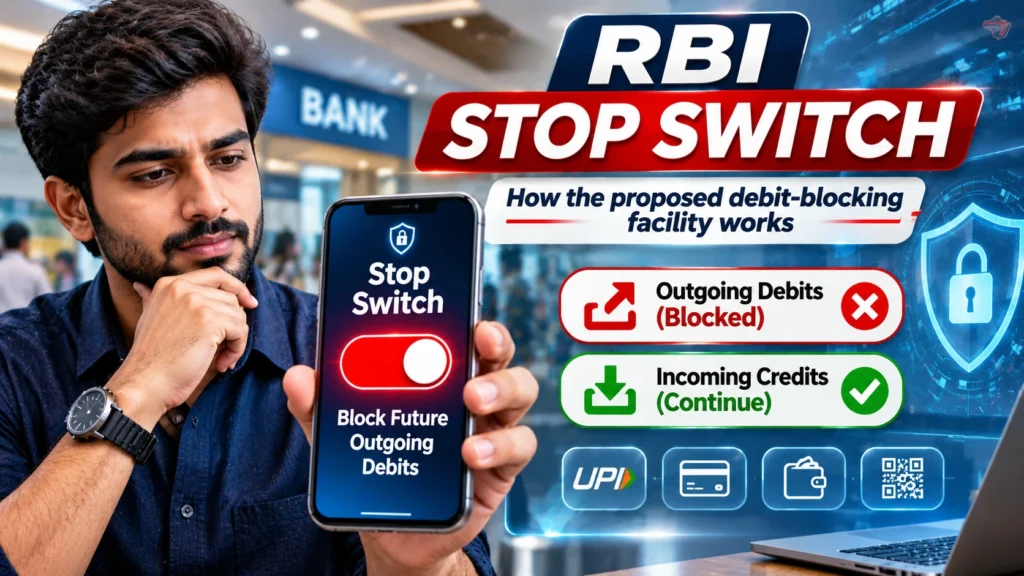
The RBI stop switch is a proposed emergency button that will let bank customers block all future debits from their accounts the moment they suspect a cyber fraud. The Reserve Bank of India released the proposal on Monday, November 23, along with a trusted person approval system for large transfers and new controls on how much money can leave your account through UPI, net banking and other digital channels.
Key Highlights
- Stop Switch will instantly block all customer-initiated debits, new mandates and new UPI app registrations.
- Customers can add a trusted person (18+) who must approve big transfers within one hour.
- All digital payment channels will be switched off by default on new accounts.
- Banks face a wider definition of negligence in fraud cases.
- Public comments are open till December 14, 2026; most rules start July 1, 2027.
What Is the RBI Stop Switch?
Think of it as a kill switch for your bank account. Under the draft rules, every bank must give customers a facility that immediately disables all future customer-initiated debits. Once you press it, no one can push money out of your account through digital channels, set up a new payment mandate or standing instruction, or register your UPI on a new third-party payment app.
Importantly, the switch does not stop everything. Your existing recurring mandates and standing instructions, bank charges, loan EMIs debited by the bank and all incoming credits will continue as usual. So your salary still comes in and your home loan EMI still goes out, but a fraudster who has your login details cannot drain the account.
How the Trusted Person Approval Will Work
The second big proposal is a Trusted Person Mechanism (TPM). It is optional. A customer can register a family member or friend aged 18 or above as an extra layer of authentication for transfers above a limit that the customer sets.
- The trusted person gets the transaction details and has one hour to approve it.
- If they reject it or do not reply in time, the transfer is declined.
- It will not apply to UPI payments, merchant payments or recurring payments via standing instructions, e-mandates and NACH.
- The trusted person gets no ownership, no right to operate the account and no financial liability.
- Banks must wait 24 hours before activating the facility.
This is aimed squarely at “digital arrest” style scams, where victims are scared into sending large sums quickly. A second person checking a big transfer can break that panic.
The aim is to add prevention, giving customers more control over how and how much their digital payment channels can be used.
RBI’s stated purpose of the draft directions
New Limits on UPI, Net Banking and Other Channels
The draft also hands customers more everyday control. You will be able to switch off individual payment channels and turn them back on later, set limits per payment, per beneficiary and per day, and even choose time windows (for example, late night) when certain channels stay disabled. For new accounts, every digital channel will be off by default and will only start after your explicit consent. Banks will also cap total transfers in the first 24 hours after a channel is activated.
According to The Tribune’s report on the seven draft directions, the rules will cover commercial banks, small finance banks, payments banks, regional rural banks and urban and rural co-operative banks. They build on RBI’s June 24, 2026 directions on customer protection in fraudulent electronic banking transactions.
Banks Face Tougher Liability
RBI wants to widen what counts as “negligence by a bank”. It would include failing to apply required authentication, not sending mandatory transaction alerts, not running 24×7 fraud reporting channels, delays in acting on complaints, system failures, security breaches and collusion by bank staff or third parties hired by banks. In such cases, the bank, not the customer, would carry more of the loss.
RBI New Rules: Key Dates at a Glance
| Item | Date |
|---|---|
| Draft directions released | November 23, 2026 |
| Last date for public comments | December 14, 2026 |
| Bank negligence rules (proposed) | January 1, 2027 |
| Stop Switch, TPM and channel controls for commercial banks (proposed) | July 1, 2027 (earlier if a bank chooses) |
These are draft rules, so details can still change after feedback. Reports also say RBI has moved away from an earlier idea of a blanket one-hour delay on large transfers and is instead giving customers tools to protect themselves.
FAQs
Is the RBI stop switch available now?
No. It is only a proposal. For commercial banks it is planned from July 1, 2027, unless a bank launches it earlier.
Will the stop switch stop my EMI or salary?
No. Existing mandates, bank-initiated debits like loan EMIs and all incoming credits continue.
Does trusted person approval apply to UPI?
No. The draft keeps UPI, merchant payments and recurring payments outside the trusted person mechanism.
Can I give feedback to RBI?
Yes. RBI has invited comments on the draft directions until December 14, 2026.
Would you use the Stop Switch or add a trusted person to your account? Tell us in the comments.
Details as reported by The Tribune (ANI), Kotak Neo and DNP India.